Members LoginJoin TCG

Trusted Knowledge, Openly Shared

View all resources

Blogs

Trends, technical deep dives, case studies and interviews from across the trusted computing community.

Documents

Searchable by technology and Work Group, with planned ISO/NIST tagging for compliance mapping.

Educational Content

Free courses and hands-on labs covering TPM, cryptography basics, TSS and attestation.

Events & Webinars

Conferences, webinars and Plugfests where the trusted computing community meets.

Github

Reference code, tools and implementations maintained by TCG and its Work Groups.

Guides & White Papers

Use-case explainers, best practices and executive summaries organised by vertical.

Public Review

Draft TCG specifications open for public comment before publication, and how to take part.

View all resources

Our Core Technologies & Standards

View all Technologies

Block Integrated Trust (BIT)

Brings trusted computing principles to block-level storage, enabling integrity, attestation, and protection of data blocks at the device layer.

Cyber Resilient Technologies (CyRes)

TCG's cyber-resilience technology for protecting persistent code, detecting unexpected states, and recovering platforms to a known trusted state.

Device Identifier Composition Engine (DICE)

Device Identifier Composition Engine establishes a unique cryptographic identity for resource-constrained devices and IoT systems with minimal hardware.

Platform Certificates

TCG's provenance artifacts asserting Roots of Trust, Trusted Building Blocks, and component composition for supply-chain assurance and attestation appraisal.

Reference Integrity Manifest (RIM)

Signed, machine-readable reference measurements used to verify a device boots and runs in its expected, trusted state.

Storage Security

TCG's architecture for interoperable security on trusted storage devices: self-encrypting drives, access control, locking, and Opal, Ruby, and Opalite classes.

TPM Software Stack (TSS)

A consistent software interface that lets applications and operating systems interact with TPM hardware across vendors, architectures, and platforms.

Trusted Platform Module (TPM)

Hardware-based root of trust that securely generates and stores cryptographic keys, attesting to the integrity of the platform it runs on.

View all Technologies

Where Experts Drive the Standards

View all Work Groups

Aerospace and Non-Terrestrial Systems Solutions

Attestation

Block Integrated Trust (BIT)

Cyber Resilient Technologies (CyRes)

Device Identifier Composition Engine (DICE)

Greater China

Infrastructure

Internet Of Things (IoT)

Japan

Mobile

Network Equipment

PC Client

Server

Storage

TPM Software Stack (TSS)

Trusted Platform Module (TPM)

Vehicle Services

Virtualized Platform

View all Work Groups

Securing Every Sector, Together

View all industries

Aerospace

Agriculture & Construction

Automotive

Education & Government

Energy & Smart Grid

Finance

Healthcare

Insurance

Manufacturing & Industrial Control

Media & Entertainment

Real Estate & Hospitality

Retail, Logistics & Transportation

Telecommunications

View all industries

Built by the Industry, for the Industry

Join TCG

About us

Learn who we are, how our standards are built, and the people and Work Groups shaping trusted computing worldwide.

Contact

Questions about membership, certification or our specifications? Get in touch with the right team.

Events

Conferences, webinars and Plugfests where the trusted computing community meets.

News

Announcements, specification releases and updates from TCG and its members.

Vulnerability Disclosure Policy

How to report vulnerabilities in TCG specifications and how TCG handles and discloses them.

Join TCG

Be Part of What's Next

Join TCG

Become a Member

Compare membership levels and find the one that matches how much you want to shape the standards.

Certifications

Certify your TPM, storage or network product against TCG compliance and security requirements.

Member Login

Access the member workspace, Work Group drafts and specifications in progress.

Member News

Product launches, milestones and announcements from across the TCG membership.

TCG Members

The companies, research institutions, government agencies and standards bodies building trusted computing together.

Join TCG

Become part of TCG

Join now
Resources/
Blogs

Save the Data: Self-Encrypting Drives

Published:
Oct 15, 20263 mins read

You do have a backup procedure for your computer already set up, right? If you don’t, now is the time to execute one. It should be easy. There are plenty of options, too. With ubiquitous cloud solutions and a myriad of online storage options, just a few clicks will suffice. Setting up a backup procedure should be high on your priorities list before the disaster strikes.
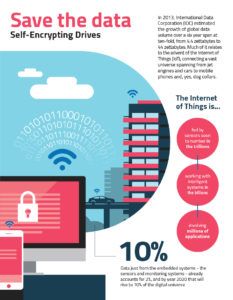
Complete new SED infographic here.

But faced with a drive failure, most users will “fix” the problem, pulling out the old hard drive in order to uncover the data and transfer it to the new drive. But what happens to the old drive? Most of us would just discard the drive (along with the computer). People do it all the time. Matt Malone, security specialist and dumpster diving hobbyist, can attest to that, describing the dumpsters as a rich treasure trove he regularly unearths, with the sheer volume of electronic equipment found in trash simply astonishing.

If Malone wouldn’t be interested in your malfunctioning devices, Simson Garfinkel surely would. An expert in data forensics, he’s hardly your ordinary scientist, but unlike Malone, he looks for used and faulty equipment with a very specific goal - to prove its hidden value. For his study “Remembrance of Data Passed,” he bought a bunch of used disk drives from auction sites, managing to extract all kind of personal data, from credit-card numbers to financial records, including medical information and trade secrets. Even a long-forgotten and discarded disk, not to mention a lost or a stolen one, is filled with a trove of data, stacked upon different layers of extractability: regular files (layer 0), temporary files (layer 1), deleted files (layer 2), retained data blocks (layer 3), vendor-hidden data (layer 4), and overwritten data (layer 5).

Shredding the redundant files and getting rid of any trace of data, from Social Security numbers, bank account details or even fond memories, all designated as “for your eyes only,” traditionally required time, effort, and sophisticated software tools that overwrite file contents and destroy the layers of data beyond recognition.

However, there’s a customer-friendly alternative, in the form of Self-Encrypting Drives (SED) with automatic data encryption, far superior to the less secure performance-heavy software-based encryption. All it takes to sanitize the drive is to simply delete the encryption key and the data is rendered worthless (Crypto-Erase is also officially recognized in the NIST SP800.88R1: Guidelines for Media Sanitization).

Hardware encryption based on Trusted Computing Group (TCG) specifications is widely adopted in most solid-state and enterprise drives as well as HDDs and many USB drives. This type of hardware encryption is always on, installed in various devices from data centers, PCs, office copiers, and printers to mobile gadgets and IoT devices. That way, in the words of Robert Thibadeau at the Drive Trust Alliance, “any government department or other organization deploying SEDs can forget about hitting the headlines for the loss of an unencrypted hard drive containing personal records.”

(Sources: Wikipedia, Kaspersky Lab, Wired)

Learn more about SEDs here: http://www.trustedcomputinggroup.org/work-groups/storage/. See SEDs in action at Flash Memory Summit, Aug. 9-11.

Explore other blogs

View all

Nov 2, 2026

4 mins read

How do hardware standards protect the aerospace sector?

Specifications like the TPM, CyRes and remote attestation secure satellites and aerospace systems end‑to‑end, ensuring trusted operations.

Oct 20, 2026

3 mins read

Ensuring device integrity with PRCR

Expanding supply chains increase tampering risks; PRCR helps manufacturers verify device integrity and ensure hardware stays trusted end‑to‑end.

Oct 15, 2026

5 mins read

Building the next generation of trusted computing experts

As the cybersecurity workforce faces a growing mismatch between available talent and the practical skills organizations need, education around trusted…

Explore other blogs

View all

Nov 2, 2026

4 mins read

How do hardware standards protect the aerospace sector?

Specifications like the TPM, CyRes and remote attestation secure satellites and aerospace systems end‑to‑end, ensuring trusted operations.

Oct 20, 2026

3 mins read

Ensuring device integrity with PRCR

Expanding supply chains increase tampering risks; PRCR helps manufacturers verify device integrity and ensure hardware stays trusted end‑to‑end.

Oct 15, 2026

5 mins read

Building the next generation of trusted computing experts

As the cybersecurity workforce faces a growing mismatch between available talent and the practical skills organizations need, education around trusted…

Become part of TCG

Membership is open to corporations, start‑ups, government, academia, and non‑profits. Join to influence specs in Work Groups, access drafts, network with experts, and submit products for TCG Certification.

Compare Membership Levels

Shape the future of trusted computing: collaborate on the development of open standards and accelerate their adoption.

trusted computing group

3855 SW 153rd Drive, Beaverton, Oregon 97003, USA

+1‑503‑619‑0562admin@trustedcomputinggroup.org

Newsletter

Get updates on TCG standards, resources, and news.

[01]

Resources

  • Documents
  • Public Review
  • TCG Blog
  • Guides & White Papers
  • Educational Content
  • Events & Webinars

[02]

Standards & Work

  • Technologies
  • Work Groups
  • Industries

[03]

Membership

  • Become a Member
  • Members
  • Member News
  • Certifications

[04]

Organization

  • About TCG
  • News & Press Releases
  • Contact
  • Vulnerability Disclosure Policy
  • Legal Notices
  • Privacy Policy

© 2026 Trusted Computing Group. All Rights Reserved